Showing posts with label voltage. Show all posts

Saturday, 2 February 2013

Fardays Law

Today i am going to give you intro about faraday's law.
Now what is faraday's law:
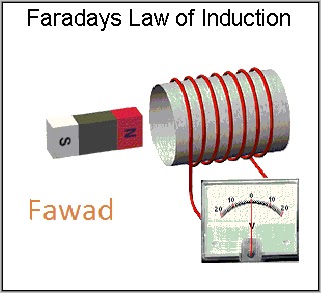
It states that rate of change of magnetic flux around a closed path produces emf (electromotive force) in other words voltage.
Now question is what is flux:
When magnetic field lines passed through any area, its called flux.
Changing magnetic flux means increasing or decreasing magnetic fields.
This can be achieved by moving a magnet in to and fro motion to the closed loop or path which causes emf in the coil.


                    EMF=-N*d(&)/dt

N: is the number of turns on the Coil
&: is the flux
-  sign: is due to lenz law

Best example is   Transformer

Electricity from Bacteria !!!!!!


Most bacteria, like all animals, get their energy from the cellular respiration process, which converts glucose and oxygen to carbon dioxide and water. Oxygen accepts electrons as it combines with other chemicals in reactions. But bacteria when underground have no oxygen to breathe. For that they produce energy for their growth by transferring electrons to rust and other surrounding metal oxides.
 Bacteria at the, converting plant and animal debris in the mud into electricity and carbon dioxide. Electrons flow through wires to a cathode sitting in water above the mud, where they combine with oxygen to complete the circuit. The bacteria are highly efficient and can produce electricity continuously for many months or even years.

Ohm's Law

Ohm law is any important law in Electrical Engineering
Ohms law states that
voltage across a resistance is equals top product of current passing through resistance;
Resistance R
Voltage V
current I

Formula:
                               V=IR


if we know any two values like current and voltage we can find other one like resistance........

Friday, 1 February 2013

Transformer

Transformer:-

it is an electrical device which step up or step down AC voltage with no change in frequency.
In its construction it contain a core made of ferromagnetic sheets which may be in F, E and I shaped.
Insulated copper wire is used as its winding.
Core has two sides primary and secondary side.
If it is step down transformer its primary side has greater number of turns of winding then Secondary.
and if it step up transformer, number of turns on primary side is less then secondary.
In both side of transformer total power remains constant that is IV (current*voltage).

We have a formula to calculate number of turns 
                            Vp/Vs  =Np/Ns
Vp is primary voltage
Vs is secondary voltage
Ns is number of secondary turns
Np is number of primary turns

Example of Step up transformer:-   Inverter which step up voltage    form 12 V to 220V Ac which is used in UPS(uninterrupted power supply)

Example of Step down transformer:-  5V DC power supply, in this power supply we have to convert 220V ac to 5V ac by step down transformer then by using bridge rectifier we can convert it in to dc

What is Diode?

It has two parts anode and cathde, anode is positive side and cathode is negative side.
Diode is like a valve, it starts conducting when it is in forward biased and stops when it is in reverse biased
now what is forward and reverse biased
farward biased means when anode is at higher potential and cathode is at lover potential like +5V at anode and -ive5V ,0V or 1V   any value less then +5V, in reverse biased anode is at lower potentential and cathode. 
it has voltage drop of 0.7 volt.

AC and DC

AC 
means Alternating current that is it changes its polarity from positive voltage to negative voltage like ifwe have 220V AC then it changes from +ive220  and -ive=220 
this changing of polarity has fix rate that is know as frequency it may be 50Hz or 60hz
Ac may be three phase or single phase
DC
means direct current, has two fixed polarities +ive and -ive, cannot change its polarity thats why it has no frequency i.e f=0Hz